

KRU Club ชุมชนออนไลน์
เข้าร่วมกลุ่มพัฒนาครู สร้างความเป็นเลิศในการสอนและแบ่งปันความรู้
เข้าร่วมกลุ่มพัฒนาครูเพื่อพัฒนาทักษะและความรู้ในการสอนร่วมแบ่งปันประสบการณ์และเตรียมพร้อมสู่การสอนที่ยอดเยี่ยม มาร่วมกันเป็นครูที่ดีที่สุด!
Integrating AI into Physics Classrooms: A Guide to Enhancing Conceptual Understanding

Neuhaus
1 เดือนที่แล้ว
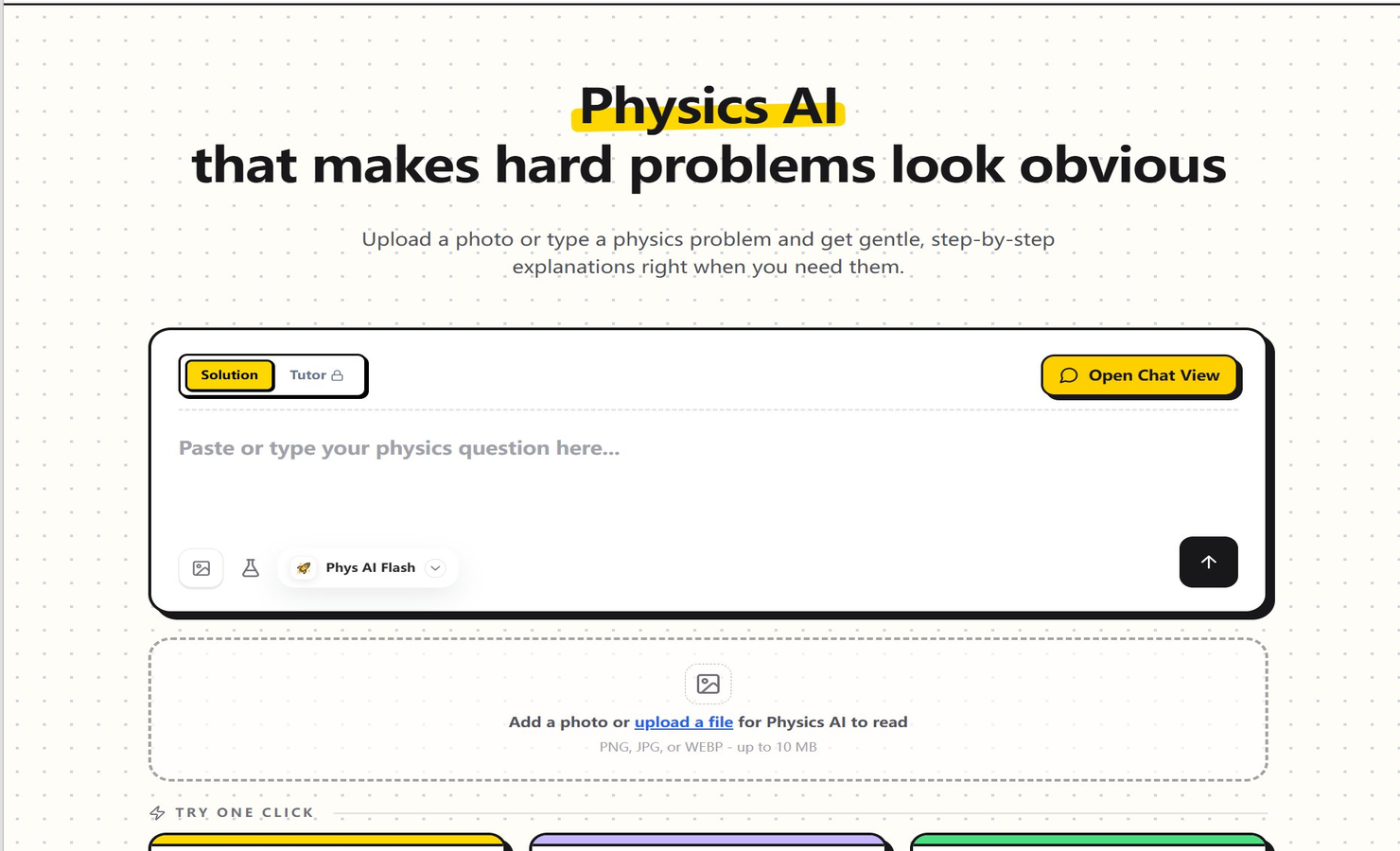
One of the most persistent challenges in STEM education is bridging the gap between abstract mathematical formulas and the physical reality they represent. For many students, a kinematic equation or a laws-of-thermodynamics problem remains a collection of symbols rather than a dynamic system. As educators explore new ways to foster engagement in a Makerspace environment, the role of specialized digital assistants has become increasingly prominent. For those looking for immediate practical applications, tools like physicsai.chat/ offer a glimpse into how generative technology can be repurposed for academic rigor rather than just simple automation.
The core issue isn't a lack of information—textbooks are filled with it—but a lack of interactive feedback. When a student gets stuck on a vector addition problem at home, the learning process often grinds to a halt. To address this, we need to shift our focus from "finding the answer" to "understanding the derivation." Here is a structured approach to integrating AI-assisted learning into the physics curriculum.
1. Identifying the "Conceptual Block"
Before introducing any tool, it is essential to diagnose where the student is struggling. Is it the algebraic manipulation, or is it the initial setup of the problem? Often, the failure occurs during the translation of a word problem into a free-body diagram. By using AI to cross-verify the initial setup, students can gain the confidence to proceed with the math, knowing their conceptual foundation is solid.
2. Visualizing Vectors and Forces
Physics is inherently visual. Concepts like torque, centripetal force, or electromagnetic induction are nearly impossible to grasp through text alone. Modern educational platforms now allow students to upload a sketch of their problem and receive a digitized, corrected version of their diagram. This feedback loop is crucial. When a student uses a physics ai solver tool to analyze a pulley system or a circuit, they aren't just getting a result; they are seeing how the forces act in real-time. This visualization helps in building the "mental models" necessary for advanced scientific thinking.
3. The Socratic Method via AI
The most effective way to use AI in a classroom setting is not as a "calculator" but as a "tutor." Instead of asking for the final velocity, students should be encouraged to ask the AI to "explain the relationship between work and kinetic energy in this specific scenario." This encourages active inquiry. By breaking down a complex derivation into five or six smaller, logical steps, the AI helps the student see the "why" behind each move.
4. Common Pitfalls to Avoid
While these tools are powerful, they are not infallible. Educators should teach students to:
Verify Units: Always check if the AI is using SI units correctly.
Question the Logic: If a result seems counter-intuitive (e.g., a car accelerating faster than gravity on a flat road), use it as a "teachable moment" to debug the AI's logic.
Input Quality: Messy handwriting or blurred photos of diagrams can lead to errors. Teach students that the quality of the output is strictly dependent on the precision of the input.
Conclusion
The goal of bringing AI into the physics lab or the Makerspace is to reduce the cognitive load of repetitive calculations, allowing students to focus on high-level analysis and creative problem-solving. By treating these digital resources as collaborative partners in the learning journey, we can make the laws of the universe feel less like a series of hurdles and more like a toolkit for innovation.
0 ชอบ
0 ตอบกลับ
118 ดู
เข้าร่วมชุมชนออนไลน์
แหล่งเรียนรู้และชุมชนออนไลน์ เพื่อนักการศึกษาและผู้ปกครอง